Quick answer
A tradesman’s tax invoice in Australia needs the same core ATO fields as any business: the words “Tax Invoice” (if you’re GST-registered), your business name, your ABN, the date of issue, a description of the work and materials, the GST amount, and the total payable. Because most trade jobs are $1,000 or more, you’ll usually also need the customer’s name or ABN on the invoice. On top of the ATO rules, trades have two extras of their own: the site address and, for licensed trades like plumbing and electrical, the licence number your state regulator expects on paperwork.
Note: this is general information, not tax advice. Cross-check with the ATO (ato.gov.au) and your state licensing body for your specific situation.
The ATO fields every tradesman invoice needs
These come straight from the ATO’s tax invoice rules - the full field-by-field detail is in our ATO tax invoice requirements checklist:
- The words “Tax Invoice” at the top - only if you’re GST-registered.
- Your business or trading name - the name on the side of the ute is fine, as long as it’s the name your ABN is registered under or a registered trading name.
- Your ABN - on every invoice, no exceptions. Without it, business customers must withhold 47% of your payment.
- Date of issue and an invoice number (INV-0001 style - technically optional, practically expected).
- A description of what you supplied - the work done and the materials used.
- The GST amount, or a clear “Total includes GST” statement.
- The total payable.
- The customer’s identity or ABN once the invoice is $1,000 or more - which covers most trade work beyond a basic call-out.
What tradies must add on top: site address and licence numbers
Two things the ATO doesn’t ask for but your industry does:
- The job or site address. On construction, repair, and installation work, the invoice should say where the work happened. Builders’ clients, strata managers, and real estate agents often refuse to pay invoices that don’t identify the property.
- Your licence number. State rules commonly require licensed trades to show their licence on quotes and invoices - electrical contractor licences in most states, plumbing licences in several, and builder registration numbers on domestic building work. Check your regulator (NSW Fair Trading, VBA in Victoria, QBCC in Queensland, and equivalents elsewhere) and put the number in your invoice footer so it’s on every document automatically.
Labour vs materials: how to lay out the line items
Separate them. One line (or more) for labour, one for materials, plus call-out and disposal where relevant. It’s what commercial clients expect, it makes GST credits obvious, and it kills the most common payment dispute (“what am I actually paying for?”) before it starts.
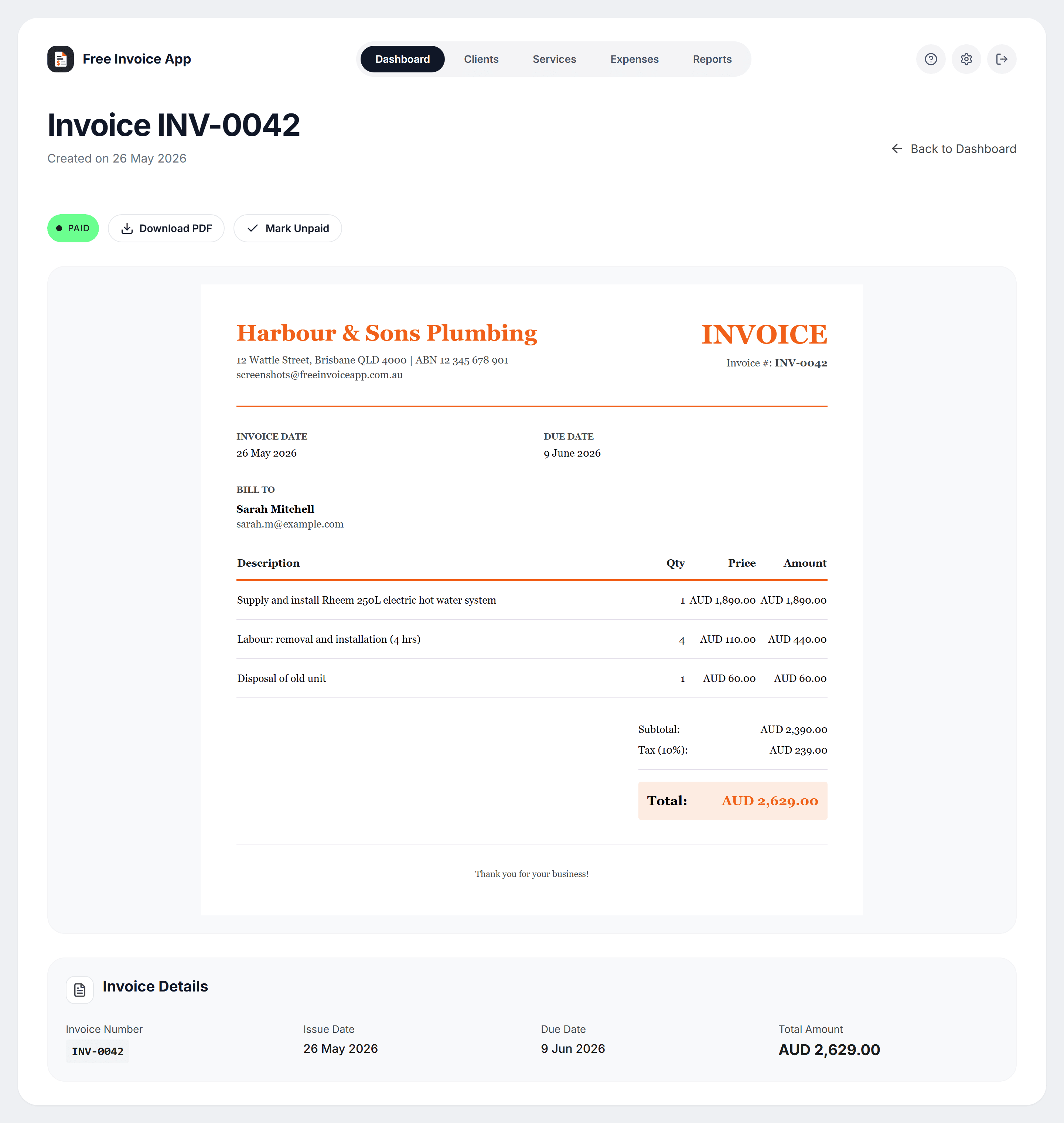
Example: a compliant tradie tax invoice
TAX INVOICE

From:
Business name: [Your Trade Business Name]
ABN: [Your ABN]
Licence no: [If required in your state]
Phone: [Phone]
Email: [Email]

Bill To:
Customer: [Customer Name or Business + ABN if $1,000+]
Site address: [Job Address]

Invoice details:
Invoice number: [INV-0001]
Invoice date: [DD/MM/YYYY]
Due date: [DD/MM/YYYY]

Work completed:
- [e.g., Replace hot water system - supply and install]

Line items:
- Call-out / inspection                   $[amount]
- Labour: [X] hours @ $[Y]/hr             $[amount]
- Materials: [itemise the big ones]       $[amount]
- Disposal / other (if applicable)        $[amount]

Subtotal (ex GST): $[amount]
GST (10%):         $[amount]
Total:             $[amount]

Payment terms:
- Payment due in [7/14/30] days
- Bank transfer: [BSB / Account]
- Reference: Invoice number
Want it pre-filled for your trade? Grab the plumber, electrician, or builder template.
GST for tradies: the $75,000 rule
GST registration is compulsory once your turnover hits $75,000 in a 12-month period. Under that, it’s your call - but many tradies register early to claim GST credits on tools, materials, and the ute. If you’re not registered: don’t charge GST, don’t show a GST line, and call the document an “Invoice”, not a “Tax Invoice”. Our guide on invoicing when not registered for GST has the exact wording.
Progress claims and deposits on bigger jobs
On larger jobs, each progress claim is its own tax invoice: its own number, its own date, and a description of the stage it covers (“Progress claim 2 of 4: frame stage”). Deposits work the same way - see how to invoice for a deposit. And if a customer pays cash, you still need to issue the invoice and keep the record - cash jobs have the same ATO paper trail.
The fast way to get all of this right
Free Invoice App pre-fills every ATO-required field: your ABN, business name, and GST treatment are saved once, invoices are numbered automatically, and you can add your licence number to the footer so it appears on every invoice. Create the invoice on your phone in the driveway, email the PDF before you’ve left the street, and track when it’s paid. The Starter plan is free with 7 sends per month - create your first invoice in under 60 seconds, or see plans (Pro is A$5/month).
Frequently asked questions
What does the ATO require on a tradesman tax invoice?
The words “Tax Invoice” (if GST-registered), your business name, ABN, date of issue, a description of the work and materials, the GST amount, and the total payable. Invoices of $1,000 or more must also show the customer’s name or ABN.
Do plumbers and electricians need a licence number on invoices?
Not for the ATO, but state licensing rules often require it - electrical work in most states, plumbing in several. Check your state regulator and add the licence number to your invoice footer.
Should labour and materials be separate line items?
Yes. The ATO only asks for a description, but separating them prevents disputes and is expected on construction and repair work.
Do tradies have to charge GST?
Only once turnover reaches $75,000 in a 12-month period. Below that it’s optional, though many register early to claim GST credits on tools and materials.
How do progress claims work with the tax invoice rules?
Each claim is its own tax invoice with its own number, date, and stage description. The same required fields apply to every claim.
What if I invoice without an ABN?
A business customer must withhold 47% of your payment under the no-ABN withholding rule. Show your ABN on every invoice.
Skip the copy/paste. Send a real invoice in 60 seconds.
Free Invoice App turns this template into an ATO-ready PDF you can email instantly. Free to start.